Showing posts with label Fractions. Show all posts

Wednesday, June 4, 2014

Worksheet Wednesday 6/4/2014

As much as we would all love to say we never use worksheets, it is virtually impossible to teach and assess without them. They are important, as long as there is a purpose behind them. They can be used as informal assessments or as a grade. 
I had a student this year who must have always been graded on worksheets because he always asked, "Is this going to be graded?" every time he received a worksheet. 
My answer was always a sarcastic "Yes," but then often followed with an explanation of, well, I am really wanting to see what you retained and if I think it shows me valid results then I will attach a grade. 
After a while, he stopped asking, especially because he realized worksheets were rare in our class and did not always equal a grade. To ease his anxiety, I told him in advance what I was grading, with the catch of, "Please do your best even if you don't think I am grading it."

Today's highlighted freebie includes a sheet that I used with my 5th graders when we worked on multiplying fractions. They had to know how to use so many different types of visuals, including repeated addition and number lines. For some reason, they really struggled with number lines, so this worksheet was great practice and helped me identify what they were confused about. 

This practice sheet is part of my Multiplication & Division with Fractions packet. The packet includes interactive notebook pages, practice sheets, task cards, story problems, and quizzes.

Hope you are able to find some use with this activity in your class, even if you don't choose to assign a grade to it! ;-)
Because I don't always read the blogs the day they are posted, I extended the 50% off deal until Wednesday 9 PM EST for those who are catching up a day late. Don't forget to swing by and snatch up these items at 50%, $1.50 each!

Don't forget to hop over to The Teaching Tribune for other free worksheets in today's link up.


Happy Summer Bloggin'

Tuesday, November 12, 2013

More Fun with Fractions


Last week, I blogged about using fraction tiles and Kidspiration with fractions as we started our fraction unit and began with reviewing the skills related to simplifying. In class we are moving forward in our fraction unit and I wanted to share a fun way we discussed looking at parts of a group and writing our answers as a fraction, parts to a whole. 
To introduce the concept of expressing an answer in a fraction form we talked about the number of girls in the class as compared to the total in our class. Then as we looked at the fraction, I asked them what the fraction meant. This might seems like a silly questions, but I wanted to emphasize that it wasn't 10/18 of a girl, it was 10 out of 18. When phrased that way they chuckled and started to catch on to what I was talking about. Then we talked about how we could find the number of boys in the class without counting them and instead using the fraction we already had. I was thrilled when they caught on to subtract to find the other fraction. We did a few more classroom related problems to help them connect to viewing fractions as ratios. (If you want a great fractions in the classroom activity, check out the one Joanne blogged about on Head Over Heels for Teaching.) 
Then, using a PowerPoint projected on the board, we practiced a little more using scenarios similar to ones they might encounter on a test. To personalize the problems and maintain their attention I used my students' names in the scenarios; that was a huge hit with my crew. As we worked through the problems I reviewed simplifying and used lots of math vocabulary.
Some problems were straight forward based on the details in the story, the others required subtracting to find the amount remaining. In the second set of problems instead of just asking them to write the answer in lowest terms, I asked them to explain how they knew it was in lowest terms.
During the review of the problems we talked about importance of where I place my numbers and that order is important. The 4 simple stories lead to a great class discussion. 
To wrap things up students were given a half sheet of the frames and wrote their own problems with a partner. 
Here are pictures of some created by my mathematicians. 

 You probably cannot read what the first one says, but it is one that elicited a lot of giggles, made me blush, and had me shaking my head. So here is a recap, "Mrs. Henderson has 3 kids and she wants to have 5 kids {gasp!} in total. How many more kids does she need? {Answer: 0, my kiddos are great but man they keep me busy! More = institutionalized My hubby had a good laugh at that one too. His answer about insanity was equivalent to mine!} They earned credit for their creativity and trying so hard!
But that wasn't it, they had more wonder up their sleeve. Here was their follow up. 
T was making a fundraiser for Mrs . Henderson's future five kids. She got $1,260 and she needs $2,000. How many dollars does she need to collect? 
Loved it! 
They really did well with their story writing and the conversations about their problems were authentic learning and I know they are going to remember how to solve this type of problem because they had to think through how to write one. 
To finish off our lesson I projected their problems and had them read them to the class and then the class solved to find the answer. We ran out of time but I have promised them that they will see the stories as morning work and for once I might not have to remind them to get started. 
The simple frames and sample stories turned in to a really great lesson with lots of smiles, math talk, a few giggles, and lots of learning. 
If you are looking for some other math ideas check out I Heart Recess and the M is for Mathematical Monday links. 


Wednesday, November 6, 2013

Fun with Fractions

I am linking up tonight with Ideas by Jivey for the Workshop Wednesday link about fractions. 

In 5th grade, we spend a lot of time talking about fractions. I actually like having the entire quarter to cover fractions requirements because it helps us develop number sense, clear up misconceptions, and practice, practice, practice! As any teacher can tell you, students do not necessarily retain all the fraction concepts previously taught. We have a lot to teach with regards to fractions, but it is the one unit I feel like we really dig down a little deeper. 
We started our unit this week, slightly behind the specified timeline but we are off to a great start. Before starting the unit,  I took time to work on divisibility rules. It is easy to teach and helps with number sense. It is another math super power I bestow on the kids and having taught it allows us to discuss it throughout our fraction unit. Knowing the rules helps the kids figure out the factors by giving them a place to start, otherwise they are just hopping around guessing and often leave numbers out. 
I always arm them with a divisibility rules chart for their notebook to refer back to throughout the unit. I like how some kids start to grasp that all even numbers are divisible by 2; how 2,3 and 6 go together just like 2,5, and 10, and 3 and 9. For some of the kids they still won't see it, but they will hear it repeatedly which helps them eventually make that number sense connection. Even if they catch on to just 2 or 3 of the rules it has an impact, especially when simplifying and finding common factors.   
Once divisibility rules are in their brains, I move on to factors and factoring rainbows. I watched one child work on prime factorization but I noticed she kept stopping after finding 1, the number, and then the basic fact. Many times she left out the other factors. If left uncorrected, she will miss the common factors between some numbers. After a quick review and reminding her to keep going until all numbers are prime, she grasped it. Showing them how to find factors before we even dive in to fractions helps, and arms them with more vocabulary to continually reference. 
After factors, common factors, and a brief rendezvous with greatest common factors, I pull out fractions and we explore equivalent fractions. I encourage the kids to talk about how they find the equivalent fractions. We take a few notes on finding equivalent fractions, often starting with multiplying by the power of one and talking about a/a is equal to 1. 
At this point I don't expect all of them to understand, I just want to have the seeds planted, so as we explore they will notice the pattern and make the connection. I like to have them armed with the vocabulary, so they use the correct words when explaining their work. 
I always project my notebook and we write the notes together. I also allow the kids to borrow my notebook to catch up on what they may have missed and it works wonders for those who are absent.
Finally, they get to "play." Fraction tiles are dragged out and they work to line up equivalent fractions. They mostly know 1/2 but cannot always explain why they are equivalent or how to get to that equivalent fraction. 
A few dabbled in it before, but they always need more practice. We will spend 3-5 days upfront and still have to review throughout the whole unit. 
Those who can get the basic fractions and equivalents will sometimes be stumped when working with a numerator higher than 1. 
Using the manipulative helps a lot. We will eventually make fraction bars for them to manipulate and keep in their notebook, but at the beginning having sets helps them feel comfortable and ready to dive in. 
Fraction tiles really help them see how they are equal when the tiles line up and are equal in size. Students who are impulsive and call out 1/4 is equivalent to 1/12 will see that is not true. Students with spatial issues will not draw disproportionate fractions making them look equivalent when they really aren't (and hum, helps me not make that error with my crummy art!). 
After spending a day exploring the tiles I project Kidspiration on the board and they use their fractions tiles to find equivalent fractions for fractions with numerators greater than 1. 
Walking around seeing their work helps me know when I can line up the tiles on the computer and can help clear up the misconceptions some might have with their tiles. They can sometimes manipulate the tiles to look like they are equivalent but on Kidspiration it will not line up and will visually be clear that they are not equivalent.
To help make the connection to multiplying by a power of 1, I will fill in the multiplication sentence in the space next to the tiles. Then they look for patterns (some really start to notice now that a/a = 1). They also start to notice fact families. 
At their desks they are working with the tiles, I talk them through and write the multiplication sentences on the board to keep modeling it. 
Some kids were not catching where I was getting the numbers from. That is expected. So on this problem I lined up the equivalent fraction and then took the 1/3 tile and put just 1 below the twelfths. Then I had them count how many twelfths equaled a third. Then that light-bulb started to flicker, "Oh, 4." 
After a few more days with equivalent fractions we will dive in to addition and subtraction and making sure that answers are in simplest form. We will continue to use fraction tiles and fraction bars to help the students grasp it visually. The math tools reinforce the skills and clear up confusion. 
As they gain confidence, some won't need them, but they will be available to everyone as often as needed. As we move to paper and pencil students may start to struggle, so the tools will help those who get lost or confused along the way.
Hopefully spending enough time on equivalents, practicing with the tiles and visual models will help students as we work toward addition and subtraction with unlike denominators. Throwing in extra steps is where students start to lose their confidence and "forget" that they really can do it. Taking time up front is important because fractions requires lots of processes and steps. Keeping it fun, making connections, and giving ample time to play and practice are the key. 
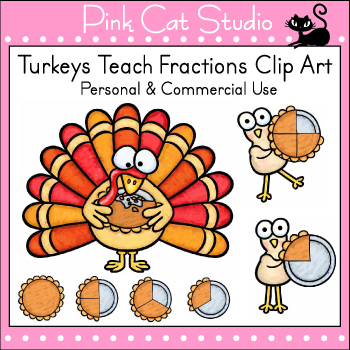
If you are teaching fractions during the month of November there are really cute turkeys and pies available from Pink Cat Studio. 
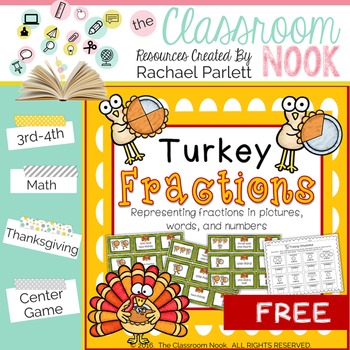
I also use these fraction match up cards to match fractions to words to numbers. This is a freebie by Rachael Parlett 
This month I will give out my half off and quarter off homework passes throughout the month. 

(Giving 1/2 off requires math to know how many to complete and they often don't catch on that they did a math problem to get out of some of the assignment!)

To keep with the turkey theme and continue the fun, we will use the turkey task cards to add and subtract. 
 There are tons of ways to work with fractions, and to practice. The more practice, the better they become at it. 
What great ideas do you have for working with fractions? If you are looking for more ideas, check out all the great links at Ideas by Jivey.