Showing posts with label Math. Show all posts

Wednesday, June 11, 2014

Worksheet Wednesday & Wordless Wednesday

I am really excited about today's freebie. In fact, my excitement inspired me to create a whole packet instead of just 1 worksheet! Click here for the whole packet. Please be kind and leave some feedback, pin it, and refer your friends. (Super huge hug & thanks!)
I am trying out Google Docs today, if you want just 1 of the pages or to preview a page, click here. (This is my first time sharing with Google Docs, if you have trouble, please let me know.)
Note: The page has a white, background, I added color on this picture, just for display purposes. Can you tell that I am having fun playing?
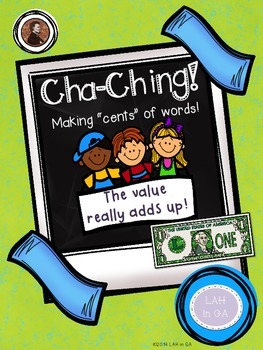
Here is the description page from Cha-Ching Words with a brief description explaining how you can use this in your classroom.  
Graphics credits:
                                          Graphics from the Pond   &     Krista Wallden
Don't forget to hop over to The Teaching Tribune to see all the other links for free worksheets. Thanks to The Teaching Tribune for hosting the fun blog party! 
If you are looking for more math freebies to use with your class(es) next year, check out these items:
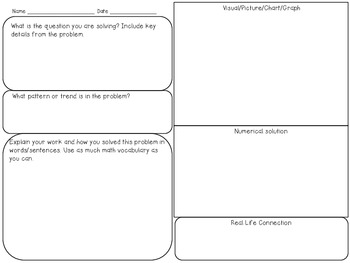
Exemplar Template to use when working on exemplars or other word problems. 
Pirate Decimal Game

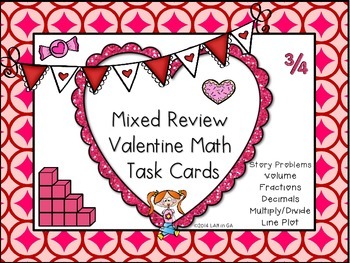
Mixed Review Math Task Cards - great for use around Valentine's Day

Hope you were able to find something that is useful to you! 

Here is a picture for the Wordless Wednesday party hosted by Christina at Sugar and Spice. 
What fun (or crazy) things have you been up to?
Thanks for stopping by! Happy Summer Bloggin' to you! 


Wednesday, June 4, 2014

Worksheet Wednesday 6/4/2014

As much as we would all love to say we never use worksheets, it is virtually impossible to teach and assess without them. They are important, as long as there is a purpose behind them. They can be used as informal assessments or as a grade. 
I had a student this year who must have always been graded on worksheets because he always asked, "Is this going to be graded?" every time he received a worksheet. 
My answer was always a sarcastic "Yes," but then often followed with an explanation of, well, I am really wanting to see what you retained and if I think it shows me valid results then I will attach a grade. 
After a while, he stopped asking, especially because he realized worksheets were rare in our class and did not always equal a grade. To ease his anxiety, I told him in advance what I was grading, with the catch of, "Please do your best even if you don't think I am grading it."

Today's highlighted freebie includes a sheet that I used with my 5th graders when we worked on multiplying fractions. They had to know how to use so many different types of visuals, including repeated addition and number lines. For some reason, they really struggled with number lines, so this worksheet was great practice and helped me identify what they were confused about. 

This practice sheet is part of my Multiplication & Division with Fractions packet. The packet includes interactive notebook pages, practice sheets, task cards, story problems, and quizzes.

Hope you are able to find some use with this activity in your class, even if you don't choose to assign a grade to it! ;-)
Because I don't always read the blogs the day they are posted, I extended the 50% off deal until Wednesday 9 PM EST for those who are catching up a day late. Don't forget to swing by and snatch up these items at 50%, $1.50 each!

Don't forget to hop over to The Teaching Tribune for other free worksheets in today's link up.


Happy Summer Bloggin'

Wednesday, November 6, 2013

Fun with Fractions

I am linking up tonight with Ideas by Jivey for the Workshop Wednesday link about fractions. 

In 5th grade, we spend a lot of time talking about fractions. I actually like having the entire quarter to cover fractions requirements because it helps us develop number sense, clear up misconceptions, and practice, practice, practice! As any teacher can tell you, students do not necessarily retain all the fraction concepts previously taught. We have a lot to teach with regards to fractions, but it is the one unit I feel like we really dig down a little deeper. 
We started our unit this week, slightly behind the specified timeline but we are off to a great start. Before starting the unit,  I took time to work on divisibility rules. It is easy to teach and helps with number sense. It is another math super power I bestow on the kids and having taught it allows us to discuss it throughout our fraction unit. Knowing the rules helps the kids figure out the factors by giving them a place to start, otherwise they are just hopping around guessing and often leave numbers out. 
I always arm them with a divisibility rules chart for their notebook to refer back to throughout the unit. I like how some kids start to grasp that all even numbers are divisible by 2; how 2,3 and 6 go together just like 2,5, and 10, and 3 and 9. For some of the kids they still won't see it, but they will hear it repeatedly which helps them eventually make that number sense connection. Even if they catch on to just 2 or 3 of the rules it has an impact, especially when simplifying and finding common factors.   
Once divisibility rules are in their brains, I move on to factors and factoring rainbows. I watched one child work on prime factorization but I noticed she kept stopping after finding 1, the number, and then the basic fact. Many times she left out the other factors. If left uncorrected, she will miss the common factors between some numbers. After a quick review and reminding her to keep going until all numbers are prime, she grasped it. Showing them how to find factors before we even dive in to fractions helps, and arms them with more vocabulary to continually reference. 
After factors, common factors, and a brief rendezvous with greatest common factors, I pull out fractions and we explore equivalent fractions. I encourage the kids to talk about how they find the equivalent fractions. We take a few notes on finding equivalent fractions, often starting with multiplying by the power of one and talking about a/a is equal to 1. 
At this point I don't expect all of them to understand, I just want to have the seeds planted, so as we explore they will notice the pattern and make the connection. I like to have them armed with the vocabulary, so they use the correct words when explaining their work. 
I always project my notebook and we write the notes together. I also allow the kids to borrow my notebook to catch up on what they may have missed and it works wonders for those who are absent.
Finally, they get to "play." Fraction tiles are dragged out and they work to line up equivalent fractions. They mostly know 1/2 but cannot always explain why they are equivalent or how to get to that equivalent fraction. 
A few dabbled in it before, but they always need more practice. We will spend 3-5 days upfront and still have to review throughout the whole unit. 
Those who can get the basic fractions and equivalents will sometimes be stumped when working with a numerator higher than 1. 
Using the manipulative helps a lot. We will eventually make fraction bars for them to manipulate and keep in their notebook, but at the beginning having sets helps them feel comfortable and ready to dive in. 
Fraction tiles really help them see how they are equal when the tiles line up and are equal in size. Students who are impulsive and call out 1/4 is equivalent to 1/12 will see that is not true. Students with spatial issues will not draw disproportionate fractions making them look equivalent when they really aren't (and hum, helps me not make that error with my crummy art!). 
After spending a day exploring the tiles I project Kidspiration on the board and they use their fractions tiles to find equivalent fractions for fractions with numerators greater than 1. 
Walking around seeing their work helps me know when I can line up the tiles on the computer and can help clear up the misconceptions some might have with their tiles. They can sometimes manipulate the tiles to look like they are equivalent but on Kidspiration it will not line up and will visually be clear that they are not equivalent.
To help make the connection to multiplying by a power of 1, I will fill in the multiplication sentence in the space next to the tiles. Then they look for patterns (some really start to notice now that a/a = 1). They also start to notice fact families. 
At their desks they are working with the tiles, I talk them through and write the multiplication sentences on the board to keep modeling it. 
Some kids were not catching where I was getting the numbers from. That is expected. So on this problem I lined up the equivalent fraction and then took the 1/3 tile and put just 1 below the twelfths. Then I had them count how many twelfths equaled a third. Then that light-bulb started to flicker, "Oh, 4." 
After a few more days with equivalent fractions we will dive in to addition and subtraction and making sure that answers are in simplest form. We will continue to use fraction tiles and fraction bars to help the students grasp it visually. The math tools reinforce the skills and clear up confusion. 
As they gain confidence, some won't need them, but they will be available to everyone as often as needed. As we move to paper and pencil students may start to struggle, so the tools will help those who get lost or confused along the way.
Hopefully spending enough time on equivalents, practicing with the tiles and visual models will help students as we work toward addition and subtraction with unlike denominators. Throwing in extra steps is where students start to lose their confidence and "forget" that they really can do it. Taking time up front is important because fractions requires lots of processes and steps. Keeping it fun, making connections, and giving ample time to play and practice are the key. 
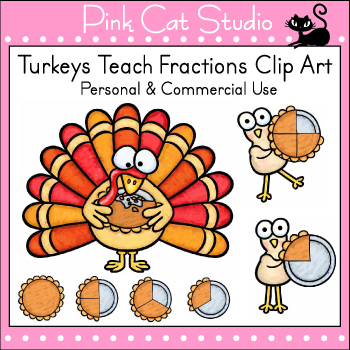
If you are teaching fractions during the month of November there are really cute turkeys and pies available from Pink Cat Studio. 
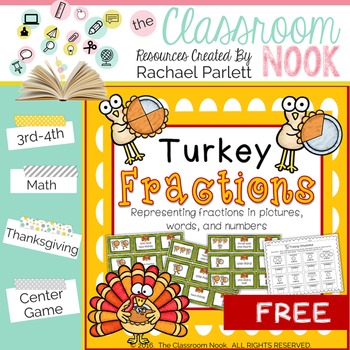
I also use these fraction match up cards to match fractions to words to numbers. This is a freebie by Rachael Parlett 
This month I will give out my half off and quarter off homework passes throughout the month. 

(Giving 1/2 off requires math to know how many to complete and they often don't catch on that they did a math problem to get out of some of the assignment!)

To keep with the turkey theme and continue the fun, we will use the turkey task cards to add and subtract. 
 There are tons of ways to work with fractions, and to practice. The more practice, the better they become at it. 
What great ideas do you have for working with fractions? If you are looking for more ideas, check out all the great links at Ideas by Jivey. 

Monday, November 4, 2013

M is for Mathematical Monday: Fall Candy Corn Math

I am excited about linking up again with I {Heart} Recess for M is for Mathematical Monday. Make sure you check out the links, there are always great ideas shared by some fantastic teachers!  

Last week I mentioned that I used Fall Candy Corn Math created by Diane at Fifth in the Middle. I loved it! Better than that, the kids enjoyed the activities a ton. 
Even though it is called Fall Candy Corn Math, I think you could adapt it for any time of the year, especially since they are selling candy corn almost year round. 
If you missed out using it in October, you could fit it in during November or in December using red/white/green candy corn, or even in February when they sell pink candy corn. 

To prepare for class, the night before I filled snack-size baggies with about 2 fistfuls of candy corn. Each group received 1 bag. It is best to not count out the amount per bag and vary the amount in each bag so the graphs show a varied amount. Varying the amount will allow you the opportunity to teach graphing intervals. 

I told the kids they would be using the candy corn and couldn't eat any of it until after the whole activity was completed. I probably could have used a little less per bag, but in total I used a huge (4 lb) bag of candy corn, packing up 40 baggies, plus a little leftover for my co-teacher and my sons. 

I grouped my math class in groups of 2-3 and before we dove in to the tasks we read through the first section to make sure they estimated before finding the actual amount.   
Not the best picture, but you can see some of the notes we jotted on the board to help the kids find the range and how to set up their graphs. Each group wrote their number on the board so the other groups could record their data.
Graphing skills are taught heavily in 3rd and 4th grade and are not emphasized nearly as much in 5th. I suppose those who wrote our curriculum believe they retain all of their previous knowledge (ha ha),  so I took some time to review how to set up the graphs (x and y axis, title), and most importantly how to set up range and select an interval. This turned out to be a necessary review lesson, as some just randomly assigned an interval of 5, then others shouted out 2, but couldn't explain why. Eventually, after looking at the data, they selected an interval of 2 or 3 based on the number of groups that had a number divisible by 2 or 3. 
Since all of the groups had more than 20 candy corn in their bags we also talked about how to show a break in the graph. Many thought it was a cool trick. It was a great chance to talk about needing to plan ahead before graphing. This helped avoid the "I can't fit it on my graph" comments. 
The kids colored in their bar graphs and finished off the front of the sheet. Most did really well with just a little bit of review. A few others needed a little more guidance, so I rotated among the groups to lend a hand or catch them before making huge errors. 

In addition to graphing the number of candy corn in each group, the packet includes some other fun activities. Students sort the candy corn in to rows of 10 and look at how many is leftover. We just discussed divisibility in class, so students talked about if the number in their bag would divide evenly and if they would have any leftover. I loved overhearing the math talk between the partners.
Some really had fun finding the length of their thumbs with the candy corn. They also discovered how many candy corn in a foot (excellent review of measuring with a ruler and the number of inches in a foot). 
Love the use of the rulers!

Another fun activity was using the candy corn to measure the sides of their desk. This could lend itself to a discussion of perimeter and area. I didn't seize that learning opportunity since some of my kiddos were about to depart for their pull-out language arts class, and I think  others were on a little overload of opening old brain files. 
The students also compared the amount of candy corn between the groups. 
My students apparently need a refresher course on averaging since some simply added all the data together. We were short on time, but when I told them they could estimate the average many successfully found a reasonable answer. If you want them to be 1000% accurate, I highly recommend reviewing averages prior to the activity.
The  back of the sheet appealed to my students because they love to color. They had a chance to design their own candy corn and then create a pattern with the colors. A few need to review how to draw patterns, but overall they did really well independently. 
The final task was surveying the class about who actually likes candy corn. Only 2 of my whole math class said they did not like it. For the sake of time, I had a student ask the question and then they raised their hands to vote yes or no. Some needed a quick reminder about tally marks, but others quickly recalled how to tally and record data. If you have time, it might be interesting to send small groups out to survey other classes and then let them compare their results. 
All in all, the tasks in the packet were fun, easy to implement and lead to great mathematical conversations and review of skills. You can prepare in advance by reviewing graphing skills, or you can complete it with mini-lessons throughout the class session. I would recommend giving yourself about an hour to complete the tasks and to handle questions. 
As they handed in their completed sheets they were rewarded with a snack bag of their own candy corn. I was rewarded with lots of smiles, a well behaved class, and a load of thank yous! 
If you are looking for something fun to do with your class I highly recommend you check out the packet at Fifth in the Middle's store on TPT. If you are completing a graphing unit, this would be a perfect activity to close up your unit. I do not have her other sets, but she also has a Lucky Charms activity and a Conversation Heart set. I bet they are just as good and the kids will have a blast with the tasks. And if you are looking for a language arts center set check out Educents, Diane's Apple for the Teacher set is available right now for free. 
What fun stuff do you do with your class as part of graphing units or to keep their interest in math?